Gauze swabs look simple: a folded piece of woven cotton. In practice, two suppliers can quote the same price per carton while delivering very different products, because the cost sits in the mesh, the thread, the ply and the packing.
This guide explains the four specifications that decide quality and price, so you can write a purchase order that leaves no room for substitution.
1. Mesh size and thread count
Gauze is defined by threads per inch in warp and weft direction. The common constructions are 19x15, 20x12 and 17x13. A 19x15 mesh is denser, absorbs faster and holds its shape better after washing. A 20x12 mesh is lighter and cheaper, and it is often used for lower-cost markets.
Thread count follows the same logic. 40s yarn is finer and softer, 32s is the mainstream export grade, and 20s is coarser but stronger. For hospital tenders in Europe, 40s with 19x15 mesh is usually the expected baseline.
2. Ply: the number that changes absorbency
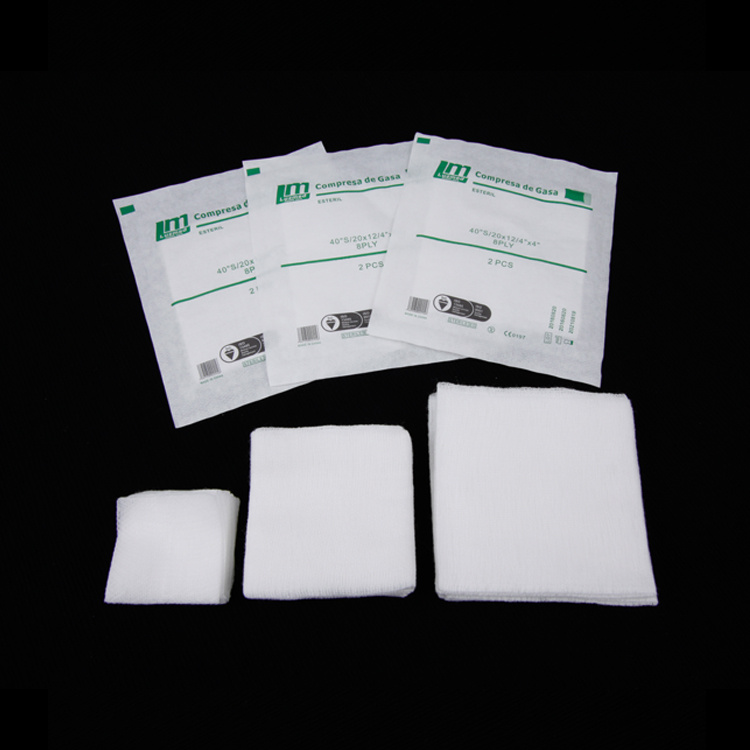
Ply is the number of gauze layers folded into one swab. Typical options are 8, 12, 16, 24 and 32 ply.
- 8 ply: light dressing, small wounds, outpatient use
- 12 ply: general purpose, the most common export specification
- 16 ply: higher absorbency, surgical use
- 24 and 32 ply: heavy drainage, larger wounds
A 10cm x 10cm 12 ply swab weighs roughly 1.2g to 1.4g. If a supplier ships noticeably lighter cartons at the same ply, check whether the mesh or yarn count was quietly reduced.
3. Size and edge finish
Standard sizes are 5cm x 5cm, 7.5cm x 7.5cm and 10cm x 10cm, plus the imperial equivalents 2" x 2", 3" x 3" and 4" x 4". Custom sizes are possible but usually require a higher minimum order quantity.
Edge finish matters for clinical use. Cut edges shed loose fibres. Folded edges keep the swab intact during use, and they cost more to produce. When a quotation looks unusually low, ask directly whether the edges are folded or cut.
4. Sterile or non-sterile
Non-sterile swabs are bulk packed, commonly 100 or 200 pieces per poly bag, and are used for cleaning and general preparation. Sterile swabs need individual or dual packing, a validated sterilization process, and full traceability.
The two mainstream sterilization methods are ethylene oxide (EO) and gamma irradiation. EO requires aeration time to release residual gas, so lead time is longer. Gamma has no residue but can slightly yellow the cotton. Both are acceptable under CE and ISO requirements when the process is validated and documented.
5. X-ray detectable swabs
For surgical use, an X-ray detectable thread is woven into the swab so it can be located if a swab is retained. The thread must be barium sulphate based and must run through the full swab. If you supply hospitals, confirm this option explicitly in the specification sheet.
What to put in your purchase order
A specification that avoids disputes includes:
- Mesh construction, for example 19x15
- Yarn count, for example 40s
- Size and ply, for example 10cm x 10cm, 12 ply
- Edge type, folded or cut
- Sterile or non-sterile, and the sterilization method
- Packing, for example 100 pcs per bag, 100 bags per carton
- Standard to be met, for example BP or EN 14079
- Certificate required, for example CE MDR class IIa plus ISO 13485
Ask for the documentation, not just the sample
A sample proves what one carton looks like. Documentation proves what every carton will look like. Ask for the CE certificate with the correct classification, the ISO 13485 certificate with a valid scope, and a recent third-party test report covering absorbency, pH value and fibre shedding.
We supply gauze swabs in all standard sizes and plies, sterile and non-sterile, with OEM packing for your own brand. Send your specification and target quantity, and we will reply with FOB price and lead time within 24 hours.